Diamond clarity grades the marks inside a stone and on its surface. For a lab-grown engagement ring you rarely need the top of the scale, and we don't think a diamond has to be perfect on paper to sparkle. You need a centre stone with nothing you can see when it's on your hand, and for most rings we'd look first at VS2 or VS1.
We list lab-grown diamonds in clarity grades from FL down to SI2. Every listing shows the certificate number and links to the lab's own record of it. Watch the stone's video where the listing has one; if it doesn't, or you want a closer look, ask us and we'll try to source one.
What clarity measures
Clarity is about two kinds of mark. Inclusions sit inside the stone. Blemishes sit on its surface, such as scratches and nicks. Some inclusions reach the surface, so the line between the two isn't always tidy, and graders call them all clarity characteristics.
The grade comes from a skilled grader looking at the stone under 10x magnification. A grade describes what a trained eye finds with a loupe, not what you'd notice across a dinner table. Through the middle of the clarity scale, inclusions usually need 10x to find. At the bottom of the scale, they can be seen with the unaided eye.
No two diamonds have the same characteristics in the same places, and gemmologists use that pattern to tell individual stones apart. A clarity plot, the diagram on some certificates, maps that pattern by marking where the main characteristics sit.
How a grader decides
A clarity grade rests on five things a grader can see at 10x:
- size: a larger inclusion is easier to find
- nature: what kind of characteristic it is, and whether it reaches the surface
- position: where it sits in the stone
- colour or relief: how much it stands out against the diamond around it
- quantity: how many there are
The grade weighs all five together, which is why two stones with the same grade can look different.
The diamond clarity scale
The clarity scale has 11 grades in six groups, from Flawless (FL) to Included (I3). The terms were standardised because older trade words such as "loupe clean" and "piqué" were easy to misread, and a grade like VVS1 or SI2 now means the same thing internationally. Most diamonds land in the VS or SI groups.
| Grade | At 10x | For you |
|---|---|---|
| FLFlawless | No inclusions and no blemishes | Top of the scale. You pay for the grade. |
| IFInternally Flawless | No inclusions, only blemishes | Looks the same as FL on your hand. |
| VVS1Very Very Slightly Included 1 | Inclusions difficult to see | Hard to find even with a loupe. |
| VVS2Very Very Slightly Included 2 | Inclusions difficult to see | Still a hunt at 10x. |
| VS1Very Slightly Included 1 | Minor inclusions, difficult to somewhat easy to see | Where we'd start for step cuts such as emerald, and large stones. |
| VS2Very Slightly Included 2 | Minor inclusions, difficult to somewhat easy to see | Where we'd start for most brilliant-style rings. |
| SI1Slightly Included 1 | Noticeable inclusions | Can be good value. Look before you buy. |
| SI2Slightly Included 2 | Noticeable inclusions | Can show unaided in larger stones and step cuts. Lowest we list. |
| I1Included 1 | Obvious inclusions that may affect transparency and brilliance | We don't list I grades. At this end, inclusions can show unaided. |
| I2Included 2 | As I1 | Not one we'd set in a ring. |
| I3Included 3 | As I1 | The bottom of the scale. |
FL
Flawless

IF
Internally Flawless

VVS
Very Very Slightly Included

VS
Very Slightly Included

SI
Slightly Included
I
Included
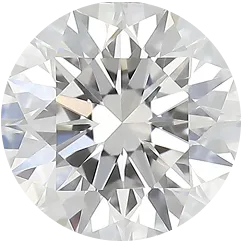
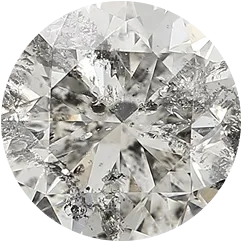
Illustrative photos of each clarity band. Every stone is different, so judge the one you're buying from its own video.
IGI and GIA certificates
IGI grades lab-grown diamonds on the same FL to I3 terms, and its certificates can include a clarity plot.
Since 1 October 2025, GIA has given lab-grown stones an assessment of Premium or Standard instead of a clarity grade, so an older GIA certificate may still show a clarity grade.
We sell stones graded by IGI and GIA. Our guide on how to check an IGI certificate walks through what's on one.
Misread grades: "S12" and "12"
"S12" is almost always SI2: S, the letter I, then 2, short for Slightly Included 2. "12" is usually I2: the letter I and 2, short for Included 2, two grades further down. If a grade looks odd, check whether the first character is a letter or a number.
Clarity in lab-grown diamonds
Lab-grown diamonds don't all come out at the top of the scale. GIA's 2024 update on lab-grown diamonds includes examples graded VVS2, VS1, VS2 and SI1. Their inclusions trace back to how they were grown, though we haven't seen good evidence that one growth method reliably gives cleaner stones than the other. Our guide to how lab-grown and mined diamonds compare covers the wider picture.
HPHT stones
HPHT (high-pressure, high-temperature) growth happens inside a capsule, where a metallic flux dissolves the carbon so it can crystallise as diamond. Traces of that metal can be trapped as the crystal grows, which leaves metallic inclusions. GIA's published examples include a metallic rod inclusion.
CVD stones
CVD (chemical vapour deposition) grows diamond from a gas mixture that's 90 to 99% hydrogen. The hydrogen is there to hold back graphite and other non-diamond carbon.
When some non-diamond carbon does get in, GIA links those inclusions, which it calls carbon nanoclusters, to a grey tint in some CVD stones.
How GIA's lab-grown assessment uses clarity
GIA's Premium and Standard assessments for lab-grown diamonds weigh clarity alongside colour, polish, symmetry and, for rounds, cut. Its assessment chart sets these clarity thresholds:
| GIA assessment | Clarity needed |
|---|---|
| Premium | VVS or better |
| Standard | VS or better |
| No assessment | Below VS |
Which clarity to choose for a lab-grown ring
For most lab-grown engagement rings, we'd start at VS2 or VS1 clarity. On a GIA lab-grown certificate, a Premium or Standard assessment means the clarity is VS or better. Go up for a step cut or a large stone; go down only once you've seen the stone.
VS1 vs VS2: where we'd start
Our default is VS2 for a round, oval or other brilliant-style stone, and VS1 when the shape or size is less forgiving. The two grades share one description at 10x, minor inclusions that are difficult to somewhat easy for a skilled grader to see, so the grade alone won't tell you how two stones differ.
VS1 costs more per carat than VS2, all else being equal. Our listings describe the VS band as clean to the naked eye, and the video is where you confirm that for the stone in front of you, so watch both before deciding whether the step up is worth it.
SI1 and SI2: look before you buy
SI1 and SI2 can be good value for a ring, but only once you've seen the stone. SI inclusions are noticeable at 10x. Some SI stones still look clean to the eye and some don't, and the grade alone won't tell you which. Our listings carry the same warning: SI inclusions can be visible unaided, particularly in larger stones and step cuts such as emerald, so they're worth viewing before you decide.
If the video shows nothing face-up and the clarity plot, where there is one, puts the marks near the edge rather than under the centre, that's an SI stone we'd consider.
VVS, IF and FL: paying for the certificate
Buy VVS, IF or FL because you want that grade on the certificate, not because you expect to see a difference on your hand. The gap between VVS and VS is one a grader finds at 10x, where VVS inclusions are difficult to see and VS ones difficult to somewhat easy; IF and FL go further still.
There's nothing wrong with wanting the top grade. Check our lab-grown diamond price history by clarity to see what the step up costs at your weight.
Colour or clarity first
If the budget forces a choice, we'd usually put cut first, then colour, then clarity, as long as the clarity looks clean to you. Colour shows across the whole stone, while an inclusion sits in one place. Once you can't see the inclusion, a higher clarity grade doesn't change the look. Our guide to colour grades covers that trade-off. At the I grades, inclusions may affect brilliance; above them, we think cut matters far more, as our guide to how cut drives sparkle explains.
Shape and size
Brilliant-style shapes such as round, oval and pear have lots of small facets that break up the light, which helps a small inclusion blend in. Step cuts such as emerald and Asscher have long, open facets that hide less.
Size works the same way: a bigger stone gives you more to look through, and where the inclusion sits still counts.
Whatever grade you settle on, search lab-grown diamonds by clarity.
What each grade step costs
Each step up the clarity scale adds to the price per carat, and how much depends on carat and colour, so we don't quote figures. Our price history tracks clarity grades from FL to SI2, which lets you see the gap between, say, VS2 and VVS2 at the weight you're after.
Lab-grown prices have fallen and the diamond is no longer most of what a ring costs, so a step up in clarity may add less to the ring's total than you'd expect.
How to check a diamond is eye-clean
When we say "eye-clean", we mean no inclusion you can see face-up without magnification. A grade can't promise that, so look: the video shows the stone the way you'll see it. We'd go through it in this order:
- Watch the stone face-up, the way it'll sit in a ring.
- Look for any dark or white mark, and keep watching it as the stone turns. A mark that stays visible all the way round is one you're likely to notice on your hand.
- Open the lab's record from the listing. If it has a clarity plot, compare it with the video: the plot tells you where to look.
- Check that the certificate number on the listing matches the lab's record.
- If anything's unclear, email [email protected] and we'll try to source another video of that stone.
We wouldn't buy a diamond we hadn't seen on video. Loose diamonds come with 30-day returns as a backstop. Rings are made to order for you, so unfortunately we can't take them back, which makes the video your best check before you order a ring.
Clarity is one of the 4Cs. Our guide to the 4Cs shows how they fit together, and our carat weight guide covers the fourth C.